How Much Does a Home Sauna Cost?
You have decided you want a sauna at home. Maybe you have been thinking about it since your last trip to Finland, or maybe a friend just finished a backyard build and you want one too. The first question that hits is the same for everyone: what is this going to cost me, all in?
The honest answer is that a home sauna in the US runs anywhere from about $1,500 for a small infrared cabin you plug into a standard outlet to $25,000 or more for a custom-built traditional sauna with a glass door, a 9 kW heater, and a licensed electrician pulling a dedicated 240V circuit. Most homeowners land somewhere between $4,000 and $12,000 all in, depending on type, size and how much of the work you do yourself.
This article breaks down what you pay by sauna type, what the hidden costs are, and what it costs to run one once it is installed. Every number is a typical range you will see quoted by manufacturers, builders and electricians in the US market. Your local rates will differ, so treat these as a starting point for your own budget.
What to expect on price
- A small infrared cabin starts around $1,500; a custom traditional build can exceed $25,000.
- Most US homeowners spend between $4,000 and $12,000 all in, including electrical work.
- Hidden costs (electrician, permit, foundation, shipping) add $1,000 to $4,000 on top of the sauna itself.
- Running cost for a typical 6 kW traditional sauna is roughly $0.60 to $0.80 per session at average US electricity rates.
- DIY framing and paneling can save $2,000 to $5,000 compared to a full turnkey build, but the 240V circuit still needs a licensed electrician.
Price ranges by sauna type
The single biggest factor in your total cost is the type of sauna you choose. A prefabricated infrared cabin that ships in a crate and plugs into a 120V outlet is a different project from a custom cedar-lined room you frame in your basement. Here are the typical purchase-price ranges you will see from US manufacturers and builders in 2024 and 2025. These cover the sauna unit or kit itself, not installation, electrical work or site prep.
| Type | Typical range | What you get | Best for |
|---|---|---|---|
| Portable infrared cabin | $1,500 to $4,000 | Pre-built cabin, 120V plug-in, 1 to 2 persons | Renters, small spaces, first-time buyers testing the idea |
| Infrared cabin (larger) | $3,000 to $6,000 | Pre-built, 120V or 240V, 2 to 4 persons, carbon or ceramic panels | Bathroom or spare room, lower heat preference |
| Indoor traditional kit | $3,000 to $8,000 | Pre-cut panels, heater, benches, ventilation kit; you assemble on site | DIY builders who want a traditional Finnish-style room |
| Barrel sauna (outdoor) | $4,000 to $10,000 | Pre-assembled or flat-pack barrel, heater included, 4 to 6 persons | Backyard or garden placement, moderate DIY |
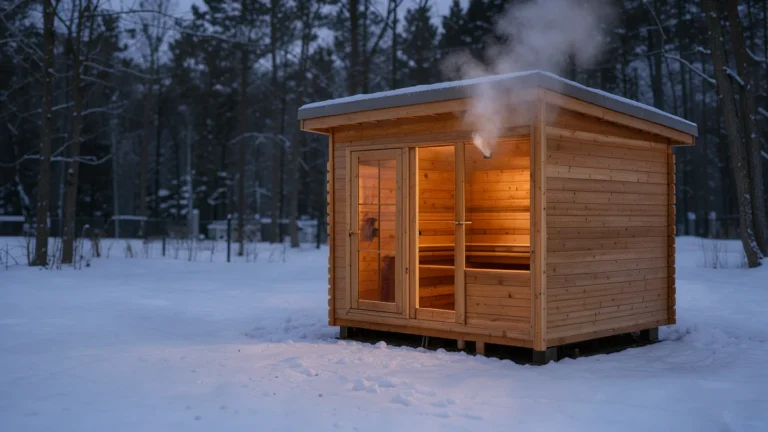
| Outdoor cabin (prefab) | $5,000 to $15,000 | Insulated cabin shell, heater, benches, delivered partially assembled | Backyard, garage pad, or pool house |
| Custom traditional build | $8,000 to $25,000+ | Framed, insulated, vapor-barriered, cedar-paneled room built on site; heater sized to volume | Basement, garage, or addition; full control over size and layout |
The costs that do not show up in the brochure
The sticker price on a sauna kit or cabin is only part of what you will spend. These are the line items that surprise people most often.
An electrician to run a dedicated 240V circuit typically charges $500 to $2,000 depending on panel distance, local rates and whether your panel has capacity. A 6 kW heater needs a 30-amp circuit; a 9 kW heater needs 40 amps. If your panel is full, a subpanel adds another $400 to $1,200.
A building permit for a detached outdoor structure or a basement remodel runs $100 to $500 in most US jurisdictions. Some areas waive it for a portable unit under a certain square footage, but check before you assume.
A foundation matters more than people expect. A barrel or outdoor cabin needs a level, stable base: a gravel pad costs $300 to $800, a concrete slab $800 to $2,500 depending on size and local concrete rates. An indoor kit on an existing basement floor may need nothing, but a wood floor under a heater needs a non-combustible pad.
Shipping for a prefabricated cabin or barrel ranges from $200 to $1,500 depending on distance and whether it ships flat-pack or fully assembled. Freight delivery to a residential address often requires a liftgate or a forklift, which can add $100 to $300.
Ventilation work in a basement or bathroom can add $200 to $1,000 if you need to cut a fresh-air intake or exhaust duct. A traditional sauna needs airflow to keep the wood dry and the heat comfortable; an infrared cabin is more forgiving but still benefits from some air exchange.
A worked example: a 6 by 8 foot traditional sauna in a garage
Here is a line-by-line example so you can see how the numbers stack up. Every assumption is stated so you can swap in your own rates.
Sauna type: custom traditional build, 6 feet by 8 feet interior, 7-foot ceiling, 336 cubic feet.
Materials (cedar panels, T&G ceiling, benches, vapor barrier, insulation, trim, door): $2,800 to $3,500. I used $3,200.
Heater: 6 kW Harvia or equivalent, sized for 336 cubic feet with a standard door: $600 to $900. I used $750.
Electrical: dedicated 30-amp 240V circuit from a panel 20 feet away, licensed electrician at $85/hour, roughly 4 hours of work plus materials: $500 to $700. I used $600.
Permit: garage accessory structure permit, small jurisdiction: $150.
Foundation: existing concrete garage floor, no new work needed: $0.
Ventilation: one 4-inch intake below the heater, one 4-inch exhaust opposite, DIY with PVC and a vent cap: $80.
Lighting and accessories (sauna-rated light, guard, thermometer/hygrometer): $150.
Total: roughly $4,930. If you hire a contractor to frame and panel the room instead of doing it yourself, add $2,000 to $4,000 for labor, bringing the total to $7,000 to $9,000.

What it costs to run
A 6 kW heater in a 336 cubic foot room takes about 45 to 60 minutes to reach 175°F (80°C) from cold. Once at temperature, it cycles on and off to hold heat. A typical 45-minute session uses roughly 4 to 5 kWh of electricity. At the US average residential rate of about $0.16 per kWh (this varies widely by state; check your utility bill), that is $0.64 to $0.80 per session.
If you use the sauna three times a week, annual running cost is roughly $100 to $125. An infrared cabin uses less, typically 1.5 to 3 kWh per session, because it heats the body more directly and the room air less. A wood-fired sauna has no electricity cost but the cost of wood, roughly $5 to $15 per session depending on your local firewood price.
Annual sauna running cost
Estimate what your sauna will cost to run each year. Enter your heater size, session length, how often you use it, and your electricity rate.
Estimated annual running cost $
Where people overspend and where they save
The most common overspend is buying a heater that is too small for the room volume, then adding a second heater or running the first one for two hours to get the room hot. That wastes money on both the heater and the electricity. Size your heater to the cubic footage of the room, not to the floor area. A 6 kW heater handles roughly 300 to 500 cubic feet with a standard door; a glass door adds heat loss and may push you to 8 or 9 kW.
The most common saving is doing the framing, insulation and paneling yourself. A DIY builder with basic carpentry skills can save $2,000 to $5,000 in labor on a custom build. The one thing you should not DIY is the 240V wiring. A licensed electrician pulls the circuit, makes the connection at the heater, and signs off on the permit. That is not a place to cut corners.
Common questions about sauna costs
Is an infrared sauna cheaper than a traditional one?
The purchase price is often lower, yes. A small infrared cabin starts around $1,500 and plugs into a standard 120V outlet, so there is no electrician cost. But if what you want is the high heat and steam of a traditional Finnish sauna, an infrared cabin will not give you that. It heats to 120 to 150°F (50 to 65°C) and does not produce löyly, which is the burst of steam you throw on hot rocks. You are paying less for a different experience.
Can I put a sauna in my basement without a permit?
In many US jurisdictions, a portable or prefabricated unit under 120 square feet does not need a building permit, but the electrical work almost always does. A 240V circuit requires an electrical permit and inspection in most areas. Check with your local building department before you start. The permit fee is small, $100 to $300 typically, and skipping it can cause problems when you sell the house.
How much does it cost to add a sauna to an existing bathroom?
If the bathroom already has a 240V circuit or panel capacity nearby, an indoor kit in a 5 by 6 foot space runs $3,000 to $6,000 for the kit plus $500 to $1,000 for electrical work. You will also need to confirm the floor can handle the load (a filled sauna with people can weigh 1,000 pounds or more) and that ventilation is adequate. A bathroom without a window or exhaust fan may need a duct run, adding $200 to $600.
Is a barrel sauna cheaper than a custom build?
Usually yes, for the same number of people. A 5-person barrel sauna from a US supplier runs $5,000 to $8,000 delivered, and you need a level pad and an electrician. A custom 5-person traditional build in a garage or addition typically runs $8,000 to $15,000 all in. The barrel is faster to install and more weather-tight out of the box, but you have less control over interior layout and bench configuration.
What is the cheapest way to get a real traditional sauna?
A used sauna kit or a small indoor kit (4 by 5 feet, 4 kW heater) installed in a spare room or closet. You can find used kits on marketplace sites for $1,000 to $2,500. Add $500 to $800 for a new heater and an electrician, and you have a traditional sauna for under $3,500. The trade-off is a small room and possibly older wood that needs refinishing.
Does a sauna add value to my home?
There is no reliable data showing a specific dollar return on a home sauna the way there is for a kitchen remodel. Some buyers value it, others do not. If you are building for your own enjoyment, that is the right reason. If you are building purely for resale, the numbers do not support it.