Sauna Electrical Requirements: Volts, Amps and Breakers Explained
You have picked your heater. It is a 6 kW Harvia or a 9 kW Tylo, and it sits in the cart in your garage waiting for the electrician. Before that call, you want to know what the electrician will actually do, what it means for your panel, and whether your existing wiring can handle it.
This article walks through the numbers: volts, amps, breaker size, and panel space. It does not give you wiring steps. A sauna heater circuit is a 240V dedicated run that must meet the National Electrical Code, and in most US jurisdictions it requires a permit and a licensed electrician. What you need is enough understanding to have a productive conversation with that electrician and to know what to ask for.
Key takeaways
- Most home sauna heaters need a dedicated 240V circuit; only small units under about 3 kW can run on 120V.
- Amps are calculated from the heater's kW rating divided by voltage, then the breaker is sized at 125 percent of that load.
- A 6 kW heater draws about 25 amps at 240V and typically needs a 30A double-pole breaker.
- Your panel needs one open double-pole slot for a 240V sauna circuit; if it is full, a subpanel or tandem breakers may be needed.
- The electrician pulls the permit, runs the wire, installs the breaker, and connects the heater to code. You do not wire it yourself.
240V is the standard for home sauna heaters
Almost every residential sauna heater sold in the US above 3 kW is rated for 240V. That is the same voltage as your electric dryer, your oven, or a central air conditioner. The heater's nameplate will say "240V" or "208-240V" and list the kW rating.
Why 240V and not 120V? Because a 6 kW heater on 120V would pull 50 amps, which exceeds what a standard household circuit can safely carry. At 240V, the same heater pulls 25 amps, which fits a dedicated 30A circuit. Higher voltage means lower current for the same power, and lower current means smaller wire and a breaker that your panel can accommodate.
If you are looking at a small infrared panel or a compact 1.5 kW heater, those may be rated for 120V and plug into a standard outlet. But a traditional Finnish-style heater that heats a room to 170 to 200°F almost always needs 240V.
How to read heater specs: kW to amps
The heater's kW rating tells you how much power it draws. To find the amps, divide the watts by the voltage. A 6 kW heater at 240V draws 6,000 watts divided by 240 volts, which is 25 amps. A 9 kW heater at 240V draws 37.5 amps.
The breaker is not sized to the exact amp draw. The NEC requires that a circuit for a continuous load (anything running three hours or more, which a sauna heater does) be sized at 125 percent of the load. So a 25-amp heater needs a circuit rated for at least 31.25 amps, which rounds up to a 30A breaker. A 37.5-amp heater needs 46.875 amps, which rounds up to a 50A breaker.
Manufacturers specify the minimum breaker size in the installation manual. That number already accounts for the 125 percent rule. When you talk to your electrician, hand them the manual and let them confirm the breaker and wire size.
| Heater kW | Amps drawn | Typical breaker | Wire gauge (copper, 75°C) |
|---|---|---|---|
| 3 kW | 12.5 A | 20A | 12 AWG |
| 4.5 kW | 18.75 A | 25A | 10 AWG |
| 6 kW | 25 A | 30A | 10 AWG |
| 8 kW | 33.3 A | 40A | 8 AWG |
| 9 kW | 37.5 A | 50A | 6 AWG |
| 10.5 kW | 43.75 A | 50A | 6 AWG |
| 12 kW | 50 A | 60A | 4 AWG |
Dedicated circuit and panel space
A sauna heater circuit must be dedicated. That means no other device shares the breaker. You cannot tap into the circuit that feeds your bathroom lights or your garage outlet. The electrician runs a new cable from the panel to the heater location, usually NM-B (Romex) in a residential setting or conduit in a garage or outdoor installation.
Panel space is the question that surprises people. A 240V circuit uses a double-pole breaker, which takes up two slots in your panel. If your panel is full, the electrician has a few options: install tandem breakers if the panel is listed for them, add a subpanel, or in some cases replace the main panel. This is a conversation to have before the heater arrives, not after.
If you are building a sauna in a garage, shed, or outdoor structure, the electrician may need to run a subpanel to that structure first. That is a separate project with its own permit, and it adds cost. Ask your electrician to quote the full run, not just the last few feet to the heater.
What your electrician does (and what you do not)
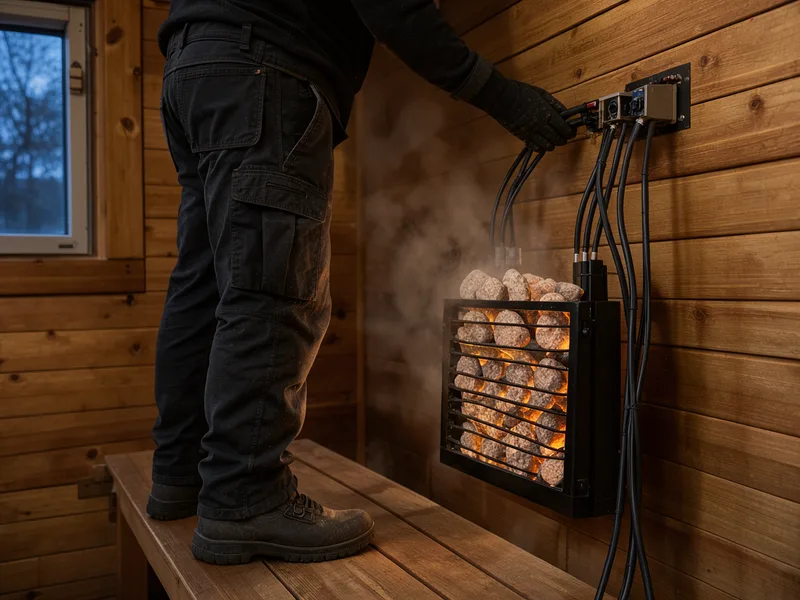
The electrician pulls the electrical permit for your jurisdiction, which means the work gets inspected. They size the wire, install the correct breaker, run the cable or conduit, and make the final connection at the heater. They follow NEC Article 422 (Appliances) and Article 210 (Branch Circuits), and they respect the heater manufacturer's clearance requirements.
You do not run the wire. You do not install the breaker. You do not connect the heater's terminal block. A sauna heater operates at temperatures above 150°F in a humid environment, and a loose connection or undersized wire in that setting is a fire risk. The permit and inspection exist to protect you.
What you do: choose the heater, read its installation manual for the minimum breaker size and wire gauge, confirm your panel has space, and hire a licensed electrician. If you are a DIY builder framing the room yourself, the electrician still handles the electrical work. That is the standard split, and it is the right one.
When 120V might work (and when it will not)
A 120V sauna heater exists, but it is limited. At 120V, a 20A circuit can deliver about 2,400 watts, so the heater tops out around 2 kW. That is enough to warm a very small infrared cabin or a one-person barrel in a well-insulated space, but it will not bring a traditional sauna room to 170°F in a reasonable time.
If you are comparing a 120V infrared panel to a 240V traditional heater, you are comparing two different experiences. The 120V unit warms you with radiant infrared panels at lower air temperature. The 240V heater heats the air and the stones, and it can produce löyly (the burst of steam you get when water hits hot rocks). If you want steam, you need 240V.
Some manufacturers make 120V versions of small heaters for the US market. Check the nameplate. If it says 120V and 15 or 20 amps, it will plug into a standard outlet, but it will not heat a room the way a 6 kW 240V heater does.
Heater amps calculator
Enter your heater's kW rating and voltage to see the amp draw. The electrician will size the breaker at 125 percent of this number.
Amps drawn by the heater A
Common questions about sauna wiring
Do I need a permit to wire a sauna heater?
In most US jurisdictions, yes. Any new 240V circuit requires an electrical permit and an inspection. Your electrician pulls the permit as part of their job. If a contractor tells you no permit is needed, that is a red flag.
Can I use an existing 240V circuit, like the one for my dryer?
No. The circuit must be dedicated to the sauna heater. Sharing a circuit with another appliance risks tripping the breaker mid-session and violates code.
What if my panel is full?
Your electrician can add a subpanel, install tandem breakers if the panel is listed for them, or replace the panel. This is a common situation in older homes and is not a dealbreaker, but it adds cost and should be quoted before you buy the heater.
Does the heater need a GFCI breaker?
Most sauna heater manufacturers do not require GFCI protection on the heater circuit itself, because the heater is a fixed appliance and GFCI nuisance tripping is common with resistive heating elements. The electrician follows the manufacturer's instructions and local code. Do not assume GFCI is needed unless the manual says so.
Can I run the wire myself and just have the electrician connect it?
No. The entire circuit, from panel to heater, must be installed by a licensed electrician to pass inspection. Running the cable is part of the permitted work.
How much does the electrical work cost?
It varies widely by region, panel condition, and distance from panel to heater. A simple dedicated run in a home with panel space might be a few hundred dollars. A subpanel plus a long run to a detached garage can be several thousand. Get a written quote that includes the permit fee.